
A command center
for your Linux servers
Inventory and monitoring, web terminal, LDAP/AD bridging, secure SSH with RADIUS + OTP, patch tracking, CVE scanning, CIS compliance, audit logging, backup and notifications — your entire Linux fleet in one panel. No agents to install on your servers.
- Deploy on your own infrastructure
- End-to-end encrypted
- Manage from one panel
A closer look
Fleet-wide summary: CIS compliance score, distro breakdown, busiest servers and update status.
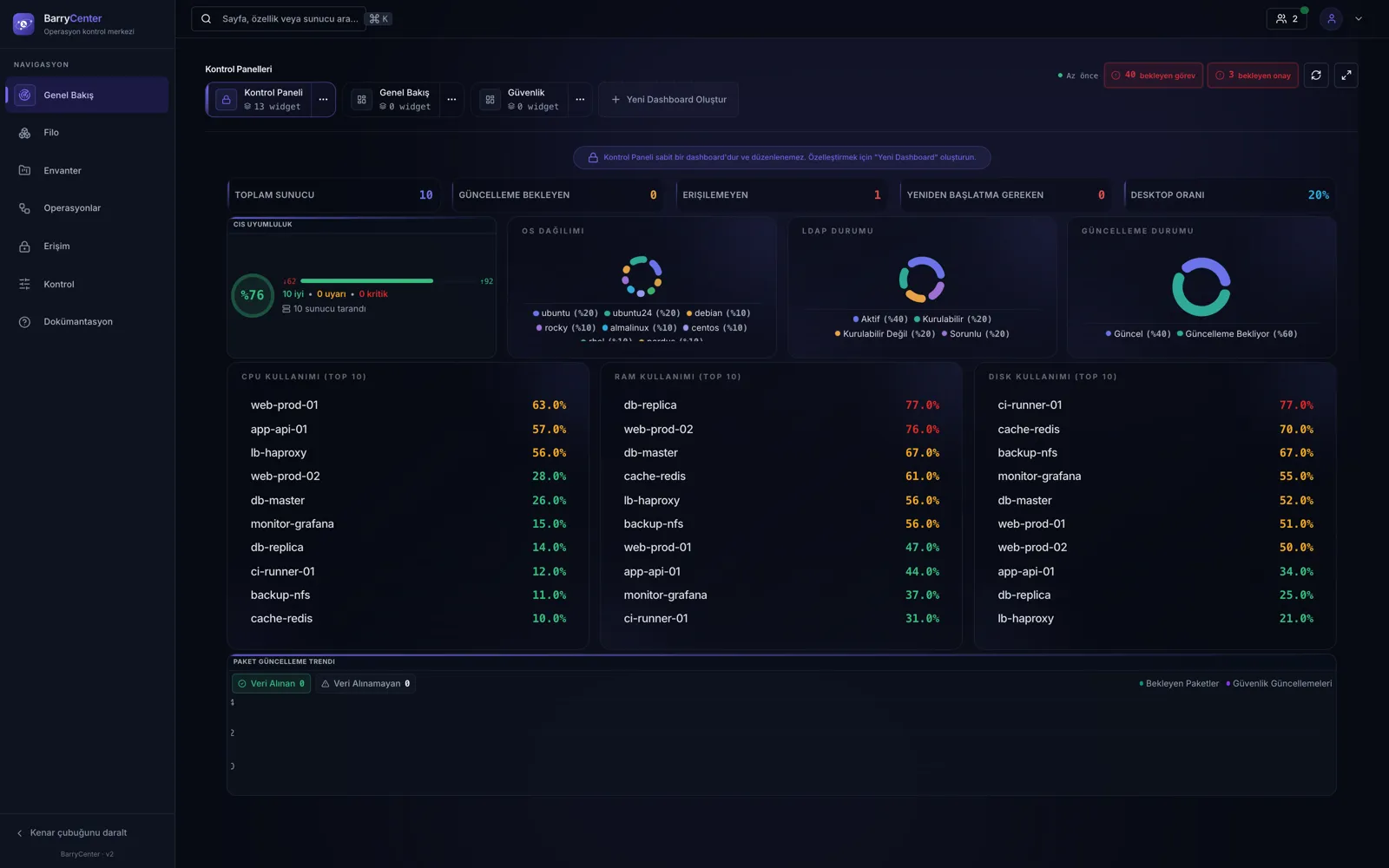
The data shown in these screens is demo data.
One platform, the whole operations layer
Fleet Management
Inventory, own and group all your Linux servers from a single panel.
CIS Compliance
Continuous scanning, score tracking, remediation guidance.
Vulnerability (CVE) Scanning
Known vulnerabilities in your servers' packages; fleet-wide view ordered by critical/high severity.
Web Terminal
SSH from the browser; every session is recorded and audited.
Containers
Docker & containerd management + live logs.
Live Metrics
CPU · RAM · disk · network, real-time with a 3-day trend.
File Tracking
Version changes to critical configuration files, see the history and get alerts.
DB Backup
Automatic detection, scheduled jobs, backup history.
Central Identity
RADIUS, OTP and role-based access; LDAP/AD integration in the On-Premise edition.
Alerts, Notifications and Reports
Alerts and notifications via email · Microsoft Teams · Slack · webhook; PDF reports.
Web Log Analysis
Parse nginx access logs: traffic, errors, top requested paths.
Audit Trail
Every state-changing action is logged with correlation.
Secure access and audit-ready records
LDAP / Active Directory bridging
Access Linux servers with your organisation's AD/LDAP accounts; who can log in where is managed centrally through groups (On-Premise edition).
Secure SSH with RADIUS + OTP
Protect SSH logins with RADIUS authentication and one-time codes (OTP / 2FA); a leaked password alone is not enough to get in.
Central access and permission management
Manage users, roles and server access from one panel, including local Linux users and their privileges.
Patch and security update tracking
See at a glance which servers have pending updates and security patches, and keep the fleet up to date.
Logging for Law No. 5651 and SIEM
User actions and SSH sessions are recorded with timestamps; records are retained and can be forwarded to your SIEM.
KVKK / data protection
In On-Premise deployments all data stays on your infrastructure; access is role-based, credentials are stored encrypted and every action goes to the audit trail.
Firewall and service management
Get firewall recommendations based on open ports; watch service status and logs from one screen.
AI-powered assistant
Ask about your servers in plain language and get recommendations. The assistant acts only with your permissions and asks for approval before any change.
Supported operating systems
Widely used enterprise and community Linux distributions are supported; manage servers from the Debian/Ubuntu, Red Hat and SUSE families from the same panel.
- Ubuntu
- Debian
- Pardus
- Red Hat Enterprise Linux
- CentOS
- AlmaLinux
- Rocky Linux
- Oracle Linux
- Amazon Linux
- Fedora
- SUSE Linux Enterprise Server
- openSUSE
On your infrastructure, or managed by us
On-Premise
Deployed to your own Linux servers with Docker; ships with install scripts and documentation, and our team guides you through it.
Your data stays on your own infrastructure. Data, identity and all control remain yours.
Cloud (SaaS)
Delivered as a SaaS service. Add your servers on AWS, Azure, Google Cloud, Hostinger and many providers, and manage them from one panel.
Your server access credentials (SSH keys, passwords) are stored encrypted; you just manage your servers.
Go to BarryCenter CloudGood to know
BarryCenter is a Linux server management platform that lets you manage, monitor and secure your Linux servers from one panel. Server inventory and monitoring, web terminal, user and permission management, LDAP/AD bridging, secure SSH with RADIUS + OTP, patch tracking, vulnerability (CVE) scanning, CIS compliance checks, logging for Law No. 5651, backup, alerts/notifications and reporting are all in one product.
Anyone running Linux servers: system administrators, IT managers, SMBs, enterprises and hosting providers. It is built for teams that want to manage a fleet of a few to hundreds of servers from one place, see security gaps and produce evidence for audits.
No. You do not need to install a separate agent; adding a server with SSH access is enough.
With On-Premise you install the product on your own Linux servers; data and control remain entirely yours, and LDAP/AD integration is available in this edition. With Cloud (SaaS) we run the service: you add your servers on providers like AWS, Azure, Google Cloud or Hostinger, your server access credentials are stored encrypted, and you just manage your servers.
Ubuntu, Debian, Pardus, Red Hat Enterprise Linux (RHEL), CentOS, AlmaLinux, Rocky Linux, Oracle Linux, Amazon Linux, Fedora, SUSE Linux Enterprise Server (SLES) and openSUSE (Leap / Tumbleweed).
Yes, in the On-Premise edition. Users access Linux servers with your organisation's AD/LDAP accounts, and which group can reach which servers is defined centrally. SSH logins can additionally be protected with RADIUS authentication and one-time codes (OTP / 2FA).
In On-Premise deployments all data stays on your own servers. In Cloud (SaaS), your server access credentials are stored encrypted and each account only sees its own servers. In both editions access is role-based and every action is written to the audit trail.
User actions and SSH sessions are recorded with timestamps, retained and can be forwarded to your SIEM; access is managed by role. These records support log retention under Turkish Law No. 5651 and access control under KVKK (Turkish data protection law); retention periods and legal assessment are defined by your organisation's policy.
Yes. Servers are scanned against CIS security controls, with a compliance score, failed checks and remediation guidance. Vulnerability scanning matches the packages on your servers against known security vulnerabilities and lists the results by severity.
Yes. Pending updates and security patches are tracked across the fleet, and you can run commands on many servers at once.
Fill in the "Request Demo" form; our team reaches out and provides the access and guidance you need to run the On-Premise product in your own environment (your own Linux servers, with Docker).
Yes. Cloud (SaaS) is live. Using the "Cloud" button you can create your account, add your servers at your provider and start managing within minutes.
No. The On-Premise product is deployed with Docker and ships with install scripts and documentation; our team can walk you through it if needed. On the Cloud side, no installation is required at all.
See the product in your own environment
Try On-Premise BarryCenter on your own Linux servers. Fill in the form and our team will reach out.
Write to us with any questions about the product, deployment models or pricing — we'll get back to you shortly.